
Menu
 
Portfolio
 
Terms of Use


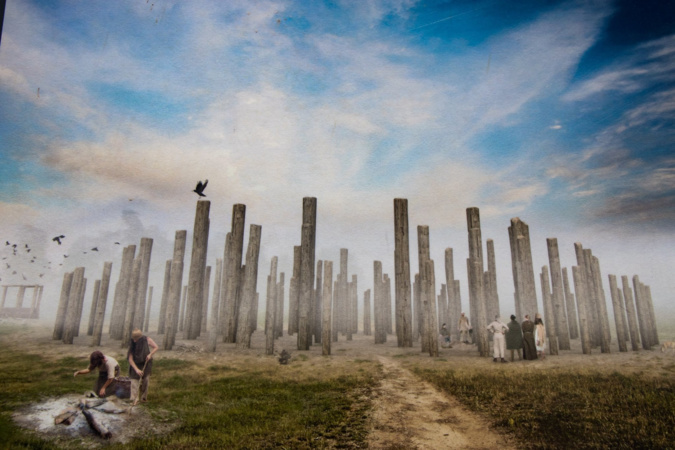
Woodhenge – Neolithic henge and timber circle monument 2 miles north-east of Stonehenge, just north of the town of Amesbury. Pottery from the excavation was identified as being consistent with the grooved ware style of the middle Neolithic, although later Beaker sherds were also found. So, the structure was probably built during the period of cultural similarities commonly known as the Beaker. The Beaker culture spans both the Late Neolithic and Britain’s Early Bronze Age and includes both the distinctive “bell beaker” type ceramic vessels for which the cultural grouping is known as well as other local styles of pottery from the Late Neolithic and Early Bronze Age.

While construction of the timber monument was probably earlier, the ditch has been dated to between 2470 and 2000 BC, which would be about the same time as, or slightly later than, construction of the stone circle at Stonehenge. Radiocarbon dating of artifacts shows that the site was still in use around 1800 BC


More posts..

Royston Cave

Royston Cave is an artificial cave located in Katherine’s Yard, Melbourn Street, Royston, England. It is located beneath the crossroads formed by Ermine Street and the Icknield Way. It has been speculated that it was used by the Knights Templar, who founded nearby Baldock, but

Read More
Powderham Castle

Powderham Castle is a fortified manor house situated within the parish and former manor of Powderham, within the former hundred of Exminster, Devon, about 6 miles south of the city of Exeter.   At some time after 1390 the medieval core of the present structure

Read More
Old Sarum

Old Sarum is the site of the earliest settlement of Salisbury in England. Located on a hill about 2 miles north of modern Salisbury near the A345 road, the settlement appears in some of the earliest records in the country.   The great monoliths of

Read More
Castle Rising

Castle Rising is a ruined medieval fortification in the village of Castle Rising, Norfolk, England. It was built soon after 1138 by William d’Aubigny II, who had risen through the ranks of the Anglo-Norman nobility to become the Earl of Arundel. With his new wealth,

Read More
Share on facebook
Share on twitter
Share on linkedin
Share on pinterest
error: