
Menu
 
Portfolio
 
Terms of Use


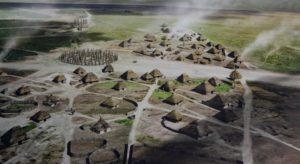
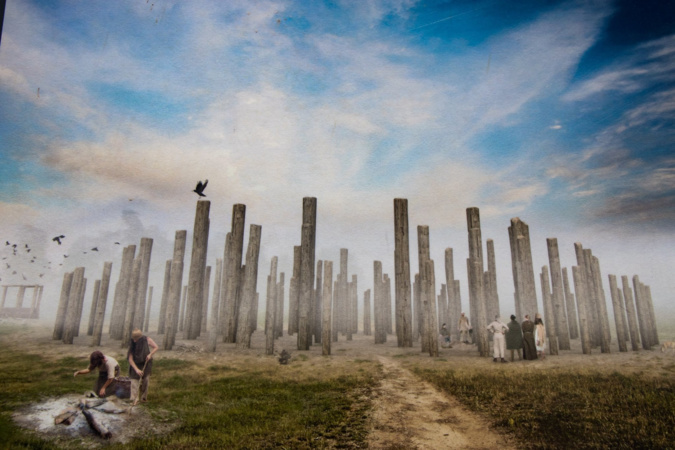
Woodhenge – Neolithic henge and timber circle monument 2 miles north-east of Stonehenge, just north of the town of Amesbury. Pottery from the excavation was identified as being consistent with the grooved ware style of the middle Neolithic, although later Beaker sherds were also found. So, the structure was probably built during the period of cultural similarities commonly known as the Beaker. The Beaker culture spans both the Late Neolithic and Britain’s Early Bronze Age and includes both the distinctive “bell beaker” type ceramic vessels for which the cultural grouping is known as well as other local styles of pottery from the Late Neolithic and Early Bronze Age.

While construction of the timber monument was probably earlier, the ditch has been dated to between 2470 and 2000 BC, which would be about the same time as, or slightly later than, construction of the stone circle at Stonehenge. Radiocarbon dating of artifacts shows that the site was still in use around 1800 BC


More posts..

Mold Castle

Mold Castle, on Bailey Hill in the town of Mold, Flintshire, Northeast Wales.   Mold Castle was built upon an existing earthwork. A motte and bailey fortress was erected c. 1072 – possibly by Robert de Montalt, a descendant of Eustace De Monte Alto, a

Read More
Blackness Castle

Blackness Castle is a 15th-century fortress, near the village of Blackness, Scotland, on the south shore of the Firth of Forth.   It was built, probably on the site of an earlier fort, by Sir George Crichton in the 1440s. At this time, Blackness was

Read More
Kenilworth Castle

Kenilworth CastleKenilworth Castle was founded in the early 1120s by Geoffrey de Clinton, Lord Chamberlain, and treasurer to Henry I. The castle’s original form is uncertain. It has been suggested that it consisted of a motte, an earthen mound surmounted by wooden buildings; however, the

Read More
Tintagel Castle

Tintagel Castle is a medieval fortification located on the peninsula of Tintagel Island adjacent to the village of Tintagel, North Cornwall. The site was possibly occupied in the Romano-British period, as an array of artefacts dating from this period have been found on the peninsula,

Read More
Share on facebook
Share on twitter
Share on linkedin
Share on pinterest
error: