
Menu
 
Portfolio
 
Terms of Use


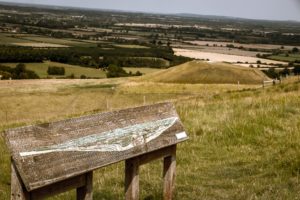
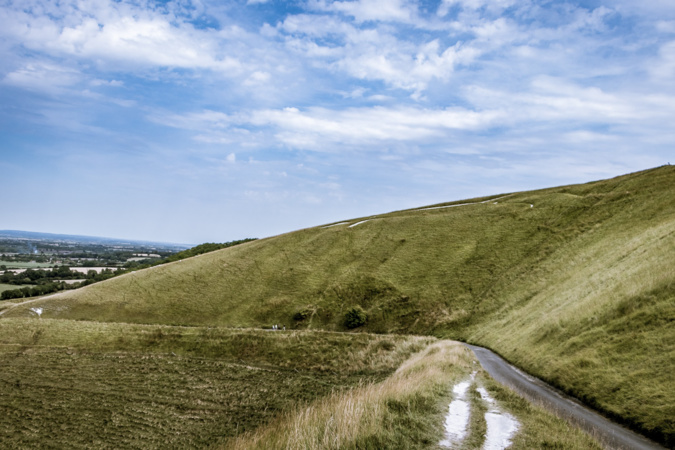
The Uffington White Horse is a prehistoric hill figure, formed from deep trenches filled with crushed white chalk.

The figure has long been presumed to date to “the later prehistory” – the Iron Age (800 BC-AD 100) or the late Bronze Age (1000–700 BC). This view was generally held by scholars before the 1990s, based on the similarity of the horse’s design to comparable figures in Celtic art. This theory was confirmed following a 1990 excavation led by Simon Palmer and David Miles of the Oxford Archaeological Unit: deposits of fine silt removed from the horse’s ‘beak’ were scientifically dated to the Late Bronze Age, sometime between 1380 and 550 BC. They also discovered the figure was cut into the hill up to a meter, not simply scratched into the chalk surface.
The medieval Welsh book Llyfr Coch Hergest (Red Book of Hergest, 1375–1425) states: “Gerllaw tref Abington y mae mynydd ac eilun march arno a gwyn ydiw. Ni thyf dim arno.” This translates as “Near to the town of Abington there is a mountain with a figure of a stallion upon it, and it is white. Nothing grows upon it.”
More posts..

Balmoral Castle

Balmoral Castle is a large estate house in Royal Deeside, Aberdeenshire, Scotland, owned by Queen Elizabeth II. It is near the village of Crathie, 9 miles west of Ballater and 50 miles west of Aberdeen.     Balmoral has been one of the residences of

Read More
Invergarry Castle

Invergarry Castle in the Scottish Highlands was the seat of the Chiefs of the Clan MacDonell of Glengarry, a powerful branch of the Clan Donald.   The castle’s position overlooking Loch Oich on Creagan an Fhithich – the Raven’s Rock – in the Great Glen,

Read More
Seven Sisters Round Barrow

  Older than Stonehenge, the Seven Sisters Round Barrow, Copt Hill, Houghton-le-Spring was excavated in 1877. They found objects from the Neolithic and Bronze Age periods. A burial urn that they found is now in the British Museum. In 2003 a sample of charcoal was

Read More
Stirling Castle

Stirling Castle, located in Stirling, is one of the largest and most important castles in Scotland, both historically and architecturally. The castle sits atop Castle Hill, an intrusive crag, which forms part of the Stirling Sill geological formation. It is surrounded on three sides by

Read More
Share on facebook
Share on twitter
Share on linkedin
Share on pinterest
error: