
Menu
 
Portfolio
 
Terms of Use


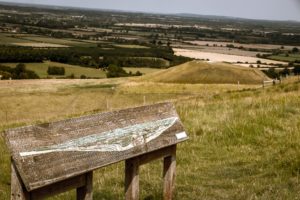
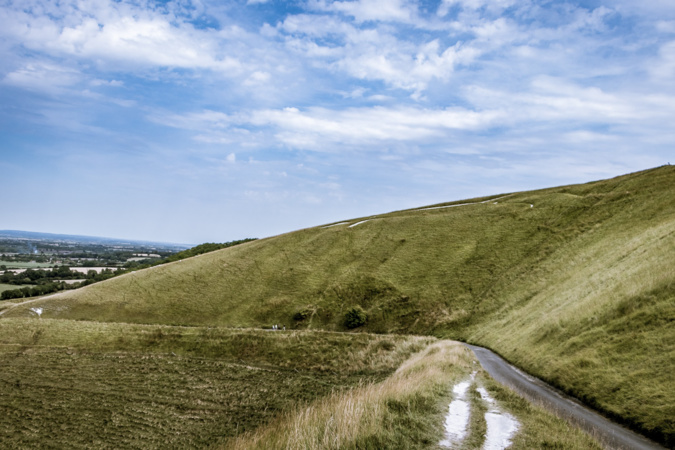
The Uffington White Horse is a prehistoric hill figure, formed from deep trenches filled with crushed white chalk.

The figure has long been presumed to date to “the later prehistory” – the Iron Age (800 BC-AD 100) or the late Bronze Age (1000–700 BC). This view was generally held by scholars before the 1990s, based on the similarity of the horse’s design to comparable figures in Celtic art. This theory was confirmed following a 1990 excavation led by Simon Palmer and David Miles of the Oxford Archaeological Unit: deposits of fine silt removed from the horse’s ‘beak’ were scientifically dated to the Late Bronze Age, sometime between 1380 and 550 BC. They also discovered the figure was cut into the hill up to a meter, not simply scratched into the chalk surface.
The medieval Welsh book Llyfr Coch Hergest (Red Book of Hergest, 1375–1425) states: “Gerllaw tref Abington y mae mynydd ac eilun march arno a gwyn ydiw. Ni thyf dim arno.” This translates as “Near to the town of Abington there is a mountain with a figure of a stallion upon it, and it is white. Nothing grows upon it.”
More posts..

Braemar Castle

Braemar Castle is situated near the village of Braemar in Aberdeenshire, Scotland. It is a possession of the chief of Clan Farquharson.   From the Late Middle Ages, the castle was a stronghold of the Earls of Mar. The present Braemar Castle was constructed in

Read More
Bungay Castle

Bungay Castle is in the town of Bungay, Suffolk by the River Waveney.   Originally this was a Norman castle built by Roger Bigod of Norfolk, around 1100, which took advantage of the protection given by the curve of the River Waveney. Roger’s son, Hugh

Read More
Colchester Castle

Colchester Castle is a Norman castle in Colchester, Essex, England, dating from the second half of the eleventh century. The keep of the castle is mostly intact and is the largest example of its kind anywhere in Europe, due to its being built on the

Read More
Warwick Castle

Warwick Castle is a medieval castle developed from a wooden fort, originally built by William the Conqueror during 1068. Warwick is the county town of Warwickshire, England, situated on a meander of the River Avon. The original wooden motte-and-bailey castle was rebuilt in stone during

Read More
Share on facebook
Share on twitter
Share on linkedin
Share on pinterest
error: