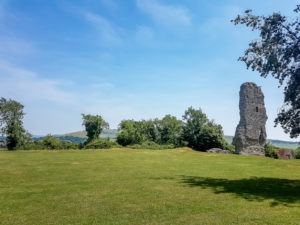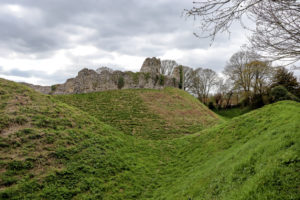



 Monmouth Castle is a castle in the town of Monmouth, the county town of Monmouthshire, southeast Wales. It is a Grade I listed building and scheduled monument. Monmouth Castle is located close to the center of Monmouth on a hill above the River Monnow, behind shops and the main square and streets. Once an important border castle, and the birthplace of Henry V of England, it stood until the English Civil War when it was damaged and changed hands three times before being slighted to prevent it from being fortified again. After the partial collapse in 1647.
Immediately after the Norman Conquest, William the Conqueror installed three of his most trusted confidants, Hugh d’Avranches, Roger de Montgomerie, and William FitzOsbern, as the Earls of Chester, Shrewsbury, and Hereford respectively. The earldoms served to guard the frontier and provided bases for the Norman invasion of Wales. Over the next four centuries, Norman lords established mostly small Marcher Lordships between the Dee and Severn, and further west. Military adventurers came to Wales from Normandy and elsewhere, raided an area of Wales, and then fortified it and granted land to some of their supporters.
William FitzOsbern established Monmouth Castle between 1066 and 1069 as a counterpart to his other major castle at Chepstow. It occupied relatively high ground, overlooking the confluence of the Monnow with the River Wye. It was originally an earth and timber ringwork fortress, which was listed in the Domesday Book. Initially, Monmouth was a fairly typical border castle in the Welsh Marches, presided over by a Marcher Lord and similar in style and status to its near neighbors Grosmont Castle, Skenfrith Castle, White Castle, and Abergavenny Castle. The wooden castle had stonework added before 1150. Its tower shares some similarities with that of Chepstow Castle, another stronghold built for FitzOsbern further south, at the lower end of the River Wye.