
Menu
 
Portfolio
 
Terms of Use
 

Mountfitchet Castle

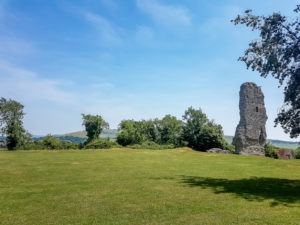
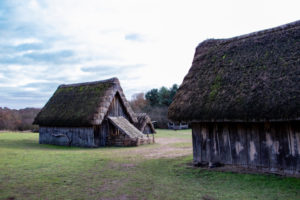
Mountfitchet Castle is a Norman ringwork and bailey fortification in Stansted Mountfitchet, Essex, England. The site is currently in use as a Living history museum, complete with livestock that would have been kept by people during the period that the castle was in use.

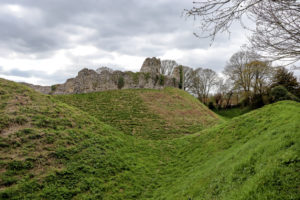
The castle was built following the Norman conquest of England by the Mountfitchet family. It was constructed on high ground with a ringwork defense, enclosing around 0.5 acres, and a bailey complex, enclosing 1 acre on slightly lower ground. Within the ringwork was a keep, within a small, round enclosure.

It is believed to have been an early Iron Age fort and Roman, Saxon, and Viking settlement. Artifacts found on the site from these periods support this belief. In 1066 the site was attacked by the Normans and Robert Gernon built his castle here, making it his chief seat and the head of his Barony. Robert Gernon (or Robert Greno as he is referred to in the Domesday Book) came over from France with William the Conqueror and was rewarded with this Lordship and several others in the County. The male line of the Gernon family continued for only five generations.


More posts..

Mold Castle

Mold Castle, on Bailey Hill in the town of Mold, Flintshire, Northeast Wales.   Mold Castle was built upon an existing earthwork. A motte and bailey fortress was erected c. 1072 – possibly by Robert de Montalt, a descendant of Eustace De Monte Alto, a

Read More
Merrivale Standing Stones

Merrivale Standing Stones and avenue – Remains of a Bronze Age settlement and a complex of ritual sites, including three stone rows, a stone circle, standing stones, and a number of cairns – earth mounds associated with burials. The monuments were probably built over a

Read More
Monmouth Castle

Monmouth Castle is a castle in the town of Monmouth, the county town of Monmouthshire, southeast Wales. It is a Grade I listed building and scheduled monument. Monmouth Castle is located close to the center of Monmouth on a hill above the River Monnow, behind

Read More
St Lythans burial chamber

  St Lythans burial chamber is a single stone megalithic dolmen, built around 6,000 BP (before present) as part of a chambered long barrow, during the mid-Neolithic period. From the end of the last ice age (between 10,000 and 12,000 BP), Mesolithic hunter-gatherers from Central

Read More
Share on facebook
Share on twitter
Share on linkedin
Share on pinterest
error: