
Menu
 
Portfolio
 
Terms of Use
 

Mountfitchet Castle

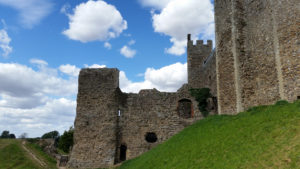
Mountfitchet Castle is a Norman ringwork and bailey fortification in Stansted Mountfitchet, Essex, England. The site is currently in use as a Living history museum, complete with livestock that would have been kept by people during the period that the castle was in use.

The castle was built following the Norman conquest of England by the Mountfitchet family. It was constructed on high ground with a ringwork defense, enclosing around 0.5 acres, and a bailey complex, enclosing 1 acre on slightly lower ground. Within the ringwork was a keep, within a small, round enclosure.

It is believed to have been an early Iron Age fort and Roman, Saxon, and Viking settlement. Artifacts found on the site from these periods support this belief. In 1066 the site was attacked by the Normans and Robert Gernon built his castle here, making it his chief seat and the head of his Barony. Robert Gernon (or Robert Greno as he is referred to in the Domesday Book) came over from France with William the Conqueror and was rewarded with this Lordship and several others in the County. The male line of the Gernon family continued for only five generations.


More posts..

Inverlochy Castle

Inverlochy Castle is a ruined, 13th-century castle near Inverlochy and Fort William, Highland, Scotland. The site of two battles, the castle remains largely unchanged since its construction.   Inverlochy Castle was built circa 1270–1280 by John “the Black” Comyn, Lord of Badenoch and Lochaber, and

Read More
Kenilworth Castle

Kenilworth CastleKenilworth Castle was founded in the early 1120s by Geoffrey de Clinton, Lord Chamberlain, and treasurer to Henry I. The castle’s original form is uncertain. It has been suggested that it consisted of a motte, an earthen mound surmounted by wooden buildings; however, the

Read More
Royston Cave

Royston Cave is an artificial cave located in Katherine’s Yard, Melbourn Street, Royston, England. It is located beneath the crossroads formed by Ermine Street and the Icknield Way. It has been speculated that it was used by the Knights Templar, who founded nearby Baldock, but

Read More
Avebury Stones

  West Kennet Stone Avenue (pictured) was an avenue of two parallel lines of stones that ran between the Neolithic sites of Avebury Ring and The Sanctuary. A second avenue, called Beckhampton Avenue led west from Avebury towards Beckhampton Long Barrow. Avebury Ring is a

Read More
Share on facebook
Share on twitter
Share on linkedin
Share on pinterest
error: