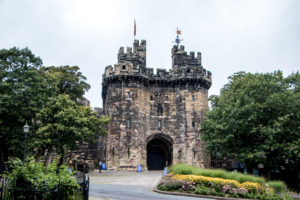



Ashby de la Zouch Castle is a ruined fortification in the town of Ashby-de-la-Zouch, Leicestershire, England. The castle was built by William, Lord Hastings, a favorite of Edward IV, after 1473, accompanied by the creation of a 3,000-acre park. Constructed on the site of an older manor house, two large towers, and various smaller buildings had been constructed by 1483, when Hastings was executed by Richard, Duke of Gloucester.
A manor had existed at Ashby-de-la-Zouch from at least 1086 when the location was known as Ascebi. The lands were acquired by Robert de Beaumont, the Count of Meulan and later Earl of Leicester, in 1100.[2] He established the Belmeis family there as his tenants and, after the Belmeis family line died out in 1160, the earls of Leicester reassigned the estate to the le Zouch family, from whom the manor took its later name.
At some point during this period, a manor house was constructed on the same site as the later castle, with a hall and a solar. A settlement grew up alongside the house and, by 1334, the town was probably the sixth-largest in the county. By the mid-1300s, the manor house reportedly included a hall, a chamber, a longhouse containing service facilities, and was surrounded by a dovecote, orchard, and a rabbit warren, accompanied by a 60-acre deer park. The hall and solar were rebuilt by the le Zouches during the second half of the 14th century, but the building remained what the historian Norman Pounds has called a “rather modest manor house”.
The le Zouch line died out in 1399, leaving the inheritance of the family estates uncertain. The manor probably passed to Sir Hugh Burnell and, around 1420, onto James Butler, the Earl of Ormond and Wiltshire. The Wars of the Roses broke out in England during 1455 between the rival supporters of the Lancastrian and Yorkist factions. James, a Lancastrian, was captured at the Battle of Towton by the Yorkist leader Edward IV in 1461 and executed; the Crown seized his estates, including the manor of Ashby de la Zouch.
Ashby de la Zouch was converted into a castle by William, Lord Hastings, a favorite of Edward IV; as a minor nobleman, he had fought alongside Edward at Towton, but was then knighted and later became the chamberlain of the royal household and the Lieutenant of Calais. William acquired extensive estates across the Midlands during the wars, much of them confiscated from his enemies. Amongst these was Ashby de la Zouch, which was given to William in 1462. His father, Sir Leonard, had maintained the family seat at nearby Kirby Muxloe, but after 1471 William began to use Ashby de la Zouch as his primary residence.