
Menu
 
Portfolio
 
Terms of Use


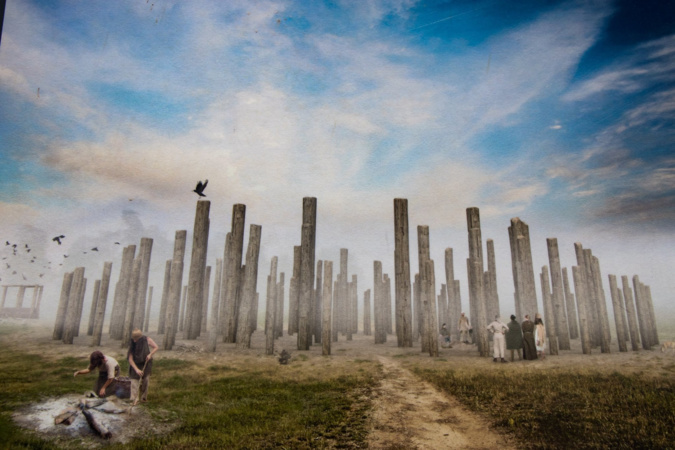
Woodhenge – Neolithic henge and timber circle monument 2 miles north-east of Stonehenge, just north of the town of Amesbury. Pottery from the excavation was identified as being consistent with the grooved ware style of the middle Neolithic, although later Beaker sherds were also found. So, the structure was probably built during the period of cultural similarities commonly known as the Beaker. The Beaker culture spans both the Late Neolithic and Britain’s Early Bronze Age and includes both the distinctive “bell beaker” type ceramic vessels for which the cultural grouping is known as well as other local styles of pottery from the Late Neolithic and Early Bronze Age.

While construction of the timber monument was probably earlier, the ditch has been dated to between 2470 and 2000 BC, which would be about the same time as, or slightly later than, construction of the stone circle at Stonehenge. Radiocarbon dating of artifacts shows that the site was still in use around 1800 BC


More posts..

Castlerigg Stone Circle

The stone circle at Castlerigg is situated near Keswick in Cumbria, North West England. One of around 1,300 stone circles in the British Isles and Brittany, it was constructed as a part of a megalithic tradition that lasted from 3,300 to 900 BC, during the

Read More
The Newark Torc

  The Newark Torc is a complete Iron Age gold alloy torc found on the outskirts of Newark-on-Trent, Nottinghamshire. The torc was probably made in Norfolk and it closely resembles the Great Torc from Snettisham and is also closely similar to one found at Sedgeford,

Read More
Jarrow Hall

Jarrow Hall (formerly Bede’s World) is a museum in Jarrow, South Tyneside, England which celebrates the life of the Venerable Bede; a monk, author, and scholar who lived at the Abbey Church of Saint Peter and Saint Paul, Wearmouth-Jarrow, a double monastery at Jarrow and

Read More
Goodrich Castle

Goodrich Castle is a Norman medieval castle ruin north of the village of Goodrich in Herefordshire, England, controlling a key location between Monmouth and Ross-on-Wye. It was praised by William Wordsworth as the “noblest ruin in Herefordshire” and is considered by historian Adrian Pettifer to

Read More
Share on facebook
Share on twitter
Share on linkedin
Share on pinterest
error: