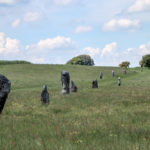


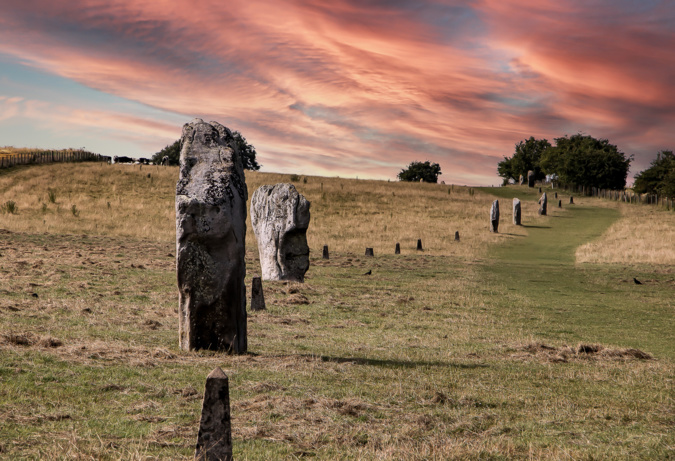
West Kennet Stone Avenue (pictured) was an avenue of two parallel lines of stones that ran between the Neolithic sites of Avebury Ring and The Sanctuary. A second avenue, called Beckhampton Avenue led west from Avebury towards Beckhampton Long Barrow.
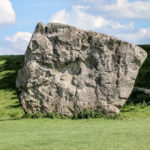
Avebury Ring is a Neolithic henge monument containing three stone circles, around the village of Avebury in Wiltshire. One of the best known prehistoric sites in Britain, it contains the largest megalithic stone circle in the world. Approximately 6,500 years older than Stonehenge and 7,000 years before the Egyptian Pyramids.
Constructed over several hundred years during the Neolithic Period, the monument comprises a large henge with a large outer stone circle and two separate smaller stone circles situated inside the center of the monument. Its original purpose is unknown, although it is believed that it was most likely used for some form of ritual or ceremony. Neolithic activity at Avebury is evidenced by flint, animal bones, and pottery such as Peterborough ware dating from the early 4th and 3rd millennia BCE.
The Avebury monument is a part of a larger prehistoric landscape containing several older monuments nearby, including West Kennet Long Barrow and Silbury Hill.
By the Iron Age, the site had been effectively abandoned, with some evidence of human activity on the site during the Roman occupation. During the Early Middle Ages, a village first began to be built around the monument, eventually extending into it.