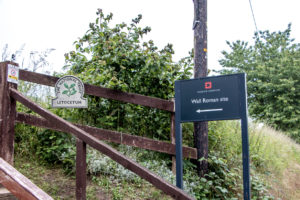



Letocetum is the ancient remains of a Roman settlement. It was an important military staging post and posting station near the junction of Watling Street, the Roman military road to North Wales, and Icknield (or Ryknild) Street (now the A38). The site is now within the parish of Wall, Staffordshire, England. It is owned and run by the National Trust, under the name Letocetum Roman Baths Site & Museum. The site is in the guardianship of English Heritage as Wall Roman Site.
The Romans came to Letocetum in 50 CE to establish a fortress during the early years of the invasion of Britain. The land could not support large numbers of soldiers and Letocetum, at an important crossroads, became a large scale posting station. The settlement developed with successive bathhouses and mansions built to serve the official travelers as well as the growing civilian population. It is known mainly from detailed excavations in 1912–13, which concentrated on the sites of the mansion and bath-house, but there is evidence of a substantial settlement with possible basilica, temples, and amphitheater.
The remains visible today are those of the stone bathhouse and mansion, built-in approximately 130 CE after Letocetum ceased to have a military function and became a civilian settlement. The settlement reached its peak during the 2nd and 3rd centuries and at this time occupied 8.1–12 hectares (20–30 acres). At the end of the 3rd century, the town relocated within high defensive walls astride Watling Street. After the Romans left early in the 5th century the settlement went into decline. The modern village of Wall emerged in the land once occupied by Letocetum.
Native settlement
It is likely that a small native settlement occupied the site before the advent of the Romans, possibly as the main trading station on the boundary between two British tribes, the Corieltauvi in the East Midlands whose later tribal center was at Ratae Corieltauvorum and the Cornovii to the west with their original capital Uriconon (which would later give its name to the important Roman British city of Viroconium) at the hill fort on The Wrekin. These tribes offered little resistance to Roman rule.