
Menu
 
Portfolio
 
Terms of Use
 

Fenwick Treasure

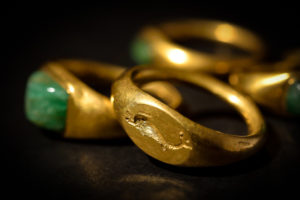
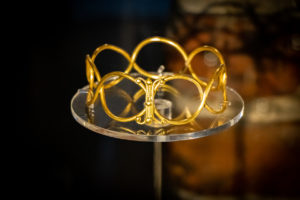
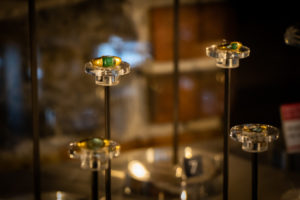
Buried for safe-keeping below the floor of a house in Roman Colchester during the Boudican revolt in AD 61. The treasure consists of 26 Roman republican coins, mostly silver, and which had been kept in a bag; the remains of a small wooden and silver jewelry box or pyxis; a gold bracelet; two gold armlets; a copper-alloy amulet necklace or bulla; a silver armlet decorated with images of panthers; two silver bracelets; five gold finger-rings, one of which is decorated with the image of a dolphin; a silver chain and loop; a pair of gold earrings; a pair of pearl earrings; and a tiny glass intaglio engraved with the image of a panther. These represent items of male and female jewelry, and the recurring motif of panthers may indicate an association with the name of the owner. One of the coins is a fascinating silver legionary denarius of Marcus Antonius, issued in 32-31 BC: it is inscribed ‘Legio XVII Classica’ and it may represent an issue of Roman military four-monthly pay on campaign or a special one-off payment on the day before the famous naval battle of Actium. The Fenwick treasure includes some beautiful jewelry and tells a remarkable story, but the silver legionary denarius has a remarkable story all of its own
More posts..

Grime’s Graves

Grime’s Graves is a large Neolithic flint mining complex in Norfolk, England. It was worked between c. 2600 and c. 2300 BC, although production may have continued well into the Bronze and Iron Ages (and later) owing to the low cost of flint compared with

Read More
Lincoln Castle

Lincoln Castle is a major Norman castle constructed in Lincoln, England, during the late 11th century by William the Conqueror on the site of a pre-existing Roman fortress. The castle is unusual in that it has two mottes. It is one of only two such

Read More
Hadleigh Castle

Hadleigh Castle is a ruined fortification in the English county of Essex, overlooking the Thames Estuary from south of the town of Hadleigh. Built after 1215 during the reign of Henry III by Hubert de Burgh, the castle was surrounded by parkland and had an

Read More
Windsor Castle

The original castle was built in the 11th century after the Norman invasion of England by William the Conqueror. Since the time of Henry I, it has been used by the reigning monarch and is the longest-occupied palace in Europe. The castle’s lavish early 19th-century

Read More
Share on facebook
Share on twitter
Share on linkedin
Share on pinterest
error: