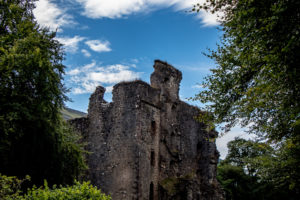



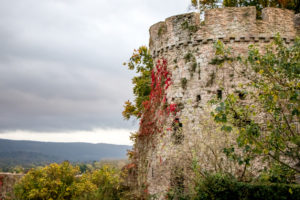
 Usk Castle is a castle site in the town of Usk in central Monmouthshire, southeast Wales, United Kingdom. Within the castle, and incorporating parts of its gatehouse, stands Castle House.
Usk castle and town was probably laid out and established in 1120, after some of the other Norman settlements and castles of the region, such as Monmouth Castle and Abergavenny Castle. However, the site had a history of the previous military, strategic, and local significance, for it was here that the Romans had established their early Legionary fortress before relocating it south to Caerleon.
Usk is first mentioned in 1138 in the context of it being captured by the Welsh. It passed back into Norman’s hands, only to be captured by the Welsh again in 1174, as was Abergavenny, when turmoil again developed into open conflict in this area of the Welsh Marches.
The Normans had to control and subjugate the region and brought in Marcher Lord Richard Fitz Gilbert de Clare who sought to strengthen the castle’s defenses against a Welsh attack, but he was ambushed and killed north of Abergavenny in 1136. The Welsh duly captured Usk castle again in 1184.
William Marshal was the next Marcher Lord to strengthen Usk castle. However, his conflict with King Henry III of England brought the Normans new headaches.
Gilbert de Clare, 7th Earl of Hertford, another holder of Usk Castle, was killed at the Battle of Bannockburn when the English crown’s focus was on defeating the Scots, and the castle was untroubled until the early 15th century. It was here, against this background, in 1352, that Adam of Usk was born.
The rebellion of Owain Glyndŵr, between 1400 and 1405, brought significant conflict to the area once again, and the Welsh forces of Owain Gyndwr attacked Usk town in 1402. The Battle of Pwll Melyn was fought nearby, and the region only stabilized under the efforts of local Welsh warrior and ally of King Henry IV of England and Monmouth-born Henry V, Davy Gam.
After the rebellion the castle passed to the Duchy of Lancaster, and, with stability restored, no further redevelopment or refortification was undertaken and the castle was allowed gradually to decay. It survived the English Civil War with only some slighting and was eventually redeveloped when the gatehouse was adapted to a house in the 1680s.