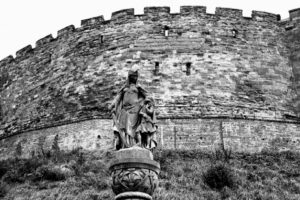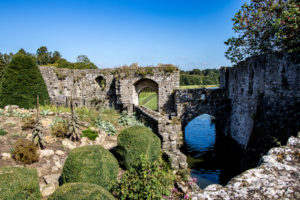



Powderham Castle is a fortified manor house situated within the parish and former manor of Powderham, within the former hundred of Exminster, Devon, about 6 miles south of the city of Exeter.
At some time after 1390 the medieval core of the present structure was built by Sir Philip Courtenay (d. 1406), the 5th or 6th son of Hugh Courtenay, 2nd Earl of Devon (d. 1377). The Earls of Devon was seated at Tiverton Castle until 1556, and their cousins of this cadet line known as “Courtenay of Powderham” continued to exist in parallel, not always on amicable terms, as prominent county gentry, arguably the leading and most prestigious gentry family of Devon, actively engaged in the local administration of Devon as JP’s, sheriffs and MP’s. From 1556 on the extinction of the senior line of Courtenay of Tiverton, the Courtenays of Powderham had become retrospectively, as was decided by law in 1831, de jure Earls of Devon, and became de facto Earls from 1831 when the title was confirmed to them in law. They had however shortly before obtained the right to sit in the House of Lords when created Viscounts.
During the Wars of the Roses, the enemies of the Courtenay Earls of Devon of Tiverton Castle were the Bonville family of Shute. Their distant cousin at Powderham, Sir William Courtenay (d. 1485) married Margaret Bonville, daughter of William Bonville, 1st Baron Bonville (1392–1461), which confirmed Powderham as a Bonville stronghold against the Earls of Devon. On 3 November 1455 Thomas de Courtenay, 5th Earl of Devon (1414–1458), at the head of a private army of 1,000 men, seized control of Exeter and its castle and laid siege to Powderham for two months. Lord Bonville attempted to raise the siege and approached from the east, crossing the River Exe; he was unsuccessful and was driven back by the earl’s forces. On 15 December 1455 the Earl of Devon and Lord Bonville met decisively at the First Battle of Clyst Heath in Exeter, where Bonville was defeated and after which the earl sacked and pillaged Shute.