

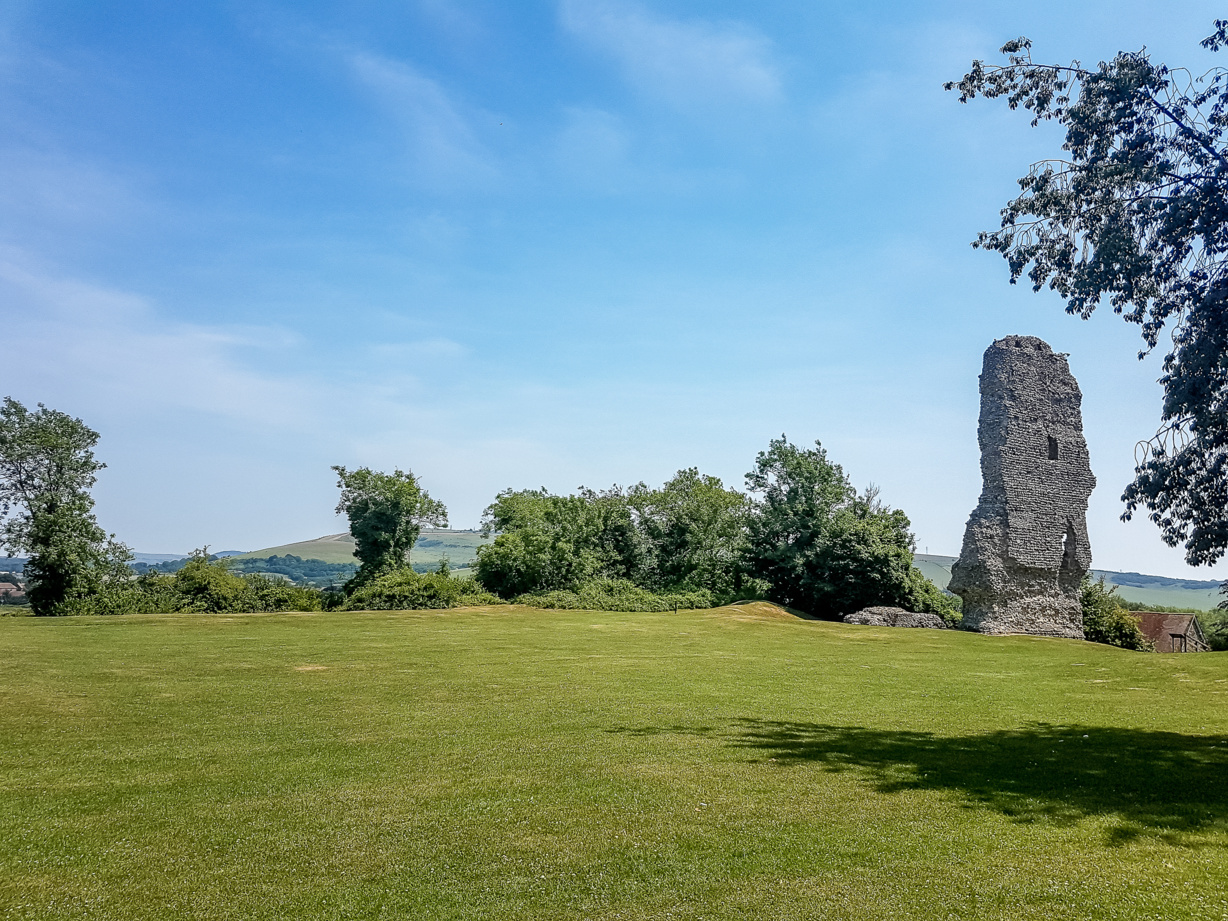
 Bramber Castle is a Norman motte-and-bailey castle formerly the caput of the large feudal barony of Bramber long held by the Braose family. It is situated in the village of Bramber, West Sussex, near the town of Steyning, overlooking the River Adur.
Surveys indicate the Normans were the first to build a fortification in the area, around 1070. It served as the administrative hub of the newly created Rape of Bramber and controlled the River Adur estuary. The castle was held by William de Braose, 1st Lord of Bramber, whose family originated from Falaise.
Except for a short period when it was confiscated by King John (1199–1216), the castle remained in the de Braose family, until the male line died out in 1326, and it passed to the Mowbrays. Bramber was one of the poorest parts of Sussex, and while it remained a center of administration, the Mowbrays did not live there; by the 1550s, it was recorded as ‘the late castle’, used for grazing.