
Menu
 
Portfolio
 
Terms of Use
 

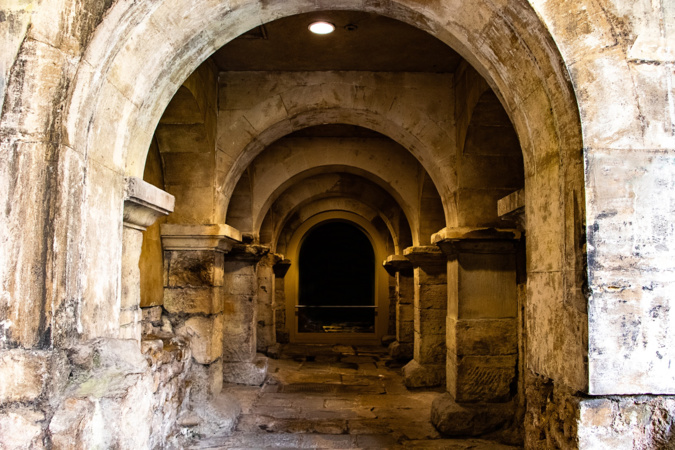
Roman Baths, Bath


Roman Baths (Bath) – The first shrine at the site of the hot springs was built by Celts, and was dedicated to the goddess Sulis, whom the Romans identified with Minerva.

The name Sulis continued to be used after the Romans arrived in Britain, leading to the town’s Roman name of Aquae Sulis (“the waters of Sulis”). The temple was constructed in 60–70 AD and the bathing complex was gradually built up over the next 300 years. Engineers drove oak piles to provide a stable foundation into the mud and surrounded the spring with an irregular stone chamber lined with lead. In the 2nd century, it was enclosed within a wooden barrel-vaulted building and included the caldarium (hot bath), tepidarium (lukewarm bath), and frigidarium (cold bath).
 

More posts..

Framlingham Castle

Framlingham Castle is a castle in the market town of Framlingham in Suffolk in England. An early motte and bailey or ringwork Norman castle was built on the Framlingham site by 1148, but this was destroyed (slighted) by Henry II of England in the aftermath

Read More
Snettisham Hoard

The Snettisham Hoard or Snettisham Treasure is a series of discoveries of Iron Age precious metal, found in the Snettisham area of the English county of Norfolk between 1948 and 1973.   The hoard consists of the metal, jet, and over 150 gold/silver/copper alloy torc

Read More
Mold Castle

Mold Castle, on Bailey Hill in the town of Mold, Flintshire, Northeast Wales.   Mold Castle was built upon an existing earthwork. A motte and bailey fortress was erected c. 1072 – possibly by Robert de Montalt, a descendant of Eustace De Monte Alto, a

Read More
Lincoln Castle

Lincoln Castle is a major Norman castle constructed in Lincoln, England, during the late 11th century by William the Conqueror on the site of a pre-existing Roman fortress. The castle is unusual in that it has two mottes. It is one of only two such

Read More
Share on facebook
Share on twitter
Share on linkedin
Share on pinterest
error: