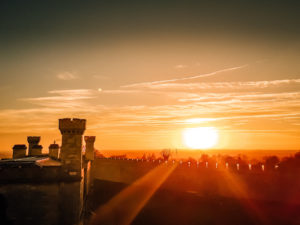



 Urquhart Castle sits beside Loch Ness in the Highlands of Scotland. The castle is on the A82 road, 21 kilometers south-west of Inverness and 2 kilometers east of the village of Drumnadrochit.
The name Urquhart derives from the 7th-century form Airdchartdan, itself a mix of the Old Irish aird (point or promontory) and Old Welsh cardden (thicket or wood). Pieces of vitrified stone, subjected to intense heat and characteristic of early medieval fortification, had been discovered at Urquhart from the early 20th century. Speculation that Urquhart may have been the fortress of Bridei son of Maelchon, king of the northern Picts, led Professor Leslie Alcock to undertake excavations in 1983. Adomnán’s Life of Columba records that St. Columba visited Bridei sometime between 562 and 586, though little geographical detail is given. Adomnán also relates that during the visit, Columba converted a Pictish nobleman named Emchath, who was on his deathbed, his son Virolec, and their household, at a place called Airdchartdan. The excavations, supported by radiocarbon dating, indicated that the rocky knoll at the south-west corner of the castle had been the site of an extensive fort between the 5th and 11th centuries. The findings led Professor Alcock to conclude that Urquhart is most likely to have been the site of Emchath’s residence, rather than that of Bridei who is more likely to have been based at Inverness, either at the site of the castle or at Craig Phadrig to the west.
Some sources state that William the Lion had a royal castle at Urquhart in the 12th century, though Professor Alcock finds no evidence for this. In the 12th and 13th centuries, the Meic Uilleim (MacWilliams), descendants of Malcolm III, staged a series of rebellions against David I and his successors. The last of these rebellions were put down in 1229, and to maintain order Alexander II granted Urquhart to his Hostarius (usher or door-ward), Thomas de Lundin. On de Lundin’s death a few years later it passed to his son Alan Durward.[15] It is considered likely that the original castle was built soon after this time, centered on the motte at the south-west of the site. In 1275, after Alan’s death, the king granted Urquhart to John II Comyn, Lord of Badenoch.
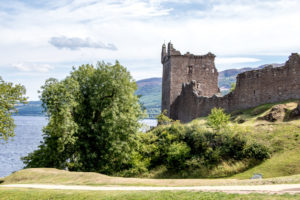 The first documentary record of Urquhart Castle occurs in 1296 when it was captured by Edward I of England. Edward’s invasion marked the beginning of the Wars of Scottish Independence, which would go on intermittently until 1357. Edward appointed Sir William fitz Warin as constable to hold the castle for the English. In 1297 he was ambushed by Sir Andrew de Moray while returning from Inverness, and Moray subsequently laid siege to the castle, launching an unsuccessful night attack.[16] The English must have been dislodged soon after since in 1298 Urquhart was again controlled by the Scots. In 1303 Sir Alexander de Forbes failed to hold off another English assault. This time Edward installed as governor Alexander Comyn, brother of John, as the family had sided with the English against Robert Bruce. Following his murder of the Red Comyn in 1306, Bruce completed his defeat of the Comyns when he marched through the Great Glen in 1307, taking the castles of Inverlochy, Urquhart, and Inverness. After this time Urquhart became a royal castle, held for the crown by a series of constables.