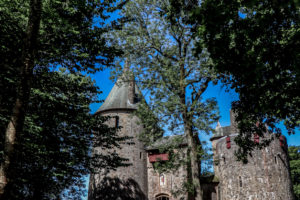



Sutton Valence Castle is a ruined medieval fortification in the village of Sutton Valence in Kent, England. Overlooking a strategic route to the coast, the original castle probably comprised an inner and an outer bailey and a protective barbican, with a three-story high keep on its southern side.
It was built in the second half of the 12th century, probably by Baldwin of Bethune, the Count of Aumale. It then passed to the families of Marshal and de Montfort, before being given by King Henry III to his half-brother William de Valence in 1265, from whom the castle takes its current name. It was abandoned in the early 14th century and fell into ruin.
Sutton Valence Castle was probably built in the second half of the 12th century by the Counts of Aumale, most likely by Baldwin of Bethune, but perhaps by William le Gros, Baldwin’s father-in-law.
The castle was built on a commanding position overlooking the strategic route between the towns of Maidstone, Rye, and Old Winchelsea and the location was also known as Sudtone and Town Sutton.
In 1203, Baldwin gave the castle to his daughter Alicia on her marriage to William Marshal, the Earl of Pembroke, who later remarried, passing the property to his second wife, Eleanor. After William’s death, Eleanor married Simon de Montfort, the Earl of Leicester. Simon led a rebellion against King Henry III during the Second Barons’ War but was killed at the Battle of Evesham in 1265, after which Eleanor lost ownership of the castle.
After the de Montfort rebellion, King Henry III gave the castle to William de Valence, his half-brother, who had supported him during the conflict. Under William, the castle and village acquired its current name of Sutton Valence. Aymer de Valence, his son, inherited the castle in 1307. The Valences traveled around their estates, increasingly focusing their attention on a handful of their various great houses, and stayed at Sutton Valence on at least several occasions.
After Aymer’s death in 1324, the castle passed by marriage to Lawrence, Lord Hastings, and was held in the Hastings family until 1390, when Reginald Lord Grey de Ruthin acquired it. There are few historical records of the castle beyond this point, but it appears to have been abandoned in the early 14th century and by the 15th century had become ruined.