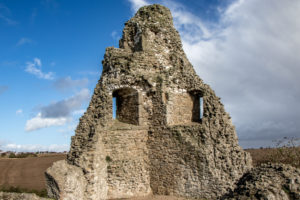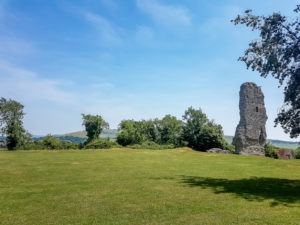



Hadleigh Castle is a ruined fortification in the English county of Essex, overlooking the Thames Estuary from south of the town of Hadleigh. Built after 1215 during the reign of Henry III by Hubert de Burgh, the castle was surrounded by parkland and had an important economic and defensive role. The castle was significantly expanded and remodeled by Edward III, who turned it into a grander property, designed to defend against a potential French attack, as well as to provide the King with a convenient private residence close to London.
Hadleigh Castle was first built by Hubert de Burgh, the 1st Earl of Kent, who was a key supporter of King John. De Burgh was given the honor of Rayleigh by John in 1215 as a reward for his services but chose not to develop the existing caput of Rayleigh Castle, instead of building a new fortification south of the town of Hadleigh. The exact date of construction is uncertain, but it is now believed the work was conducted early in de Burgh’s tenure of the site, permission being retrospectively officially confirmed through a license to crenelate in 1230 under Henry III.
The site was chosen on top of the South Essex south ridge, overlooking the Thames estuary, formed from generally soft deposits of London clay. In the 13th century, marshlands would have stretched away to the south of the castle, with the tide occasionally reaching up as far as the base of the hill itself, and the area would have been more wooded than today. By 1235 the park of Hadleigh had been formed around the castle, including woodland, a fishpond, stables, and a park lodge, but the castle was also associated with a wider estate including Rayleigh, Thundersley, and Eastwood Parks.
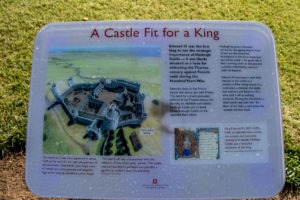
The first castle built on the site was probably of an octagonal design, running along the top of the ridge, protected by square and semi-circular mural towers, with a barbican guarding the eastern entrance. It probably resembled White Castle, remodeled by de Burgh in the same period, or Bolingbroke and Beeston Castles, both built in the 1220s. The castle was built of Kentish ragstone and cemented by a mortar containing a large proportion of seashells, particularly cockleshells from the cockle beds of neighboring Canvey Island. A valuable tidal watermill had been built by 1249, essential for making bread for the castle; recent archaeological work suggests that it was positioned on a wharf reaching out into the estuary just to the south-east of the castle. Terraced gardens were built along the south side of the castle overlooking the estuary, probably including vineyards.
De Burgh finally fell out of favor with Henry III; he was imprisoned and then finally stripped of Hadleigh Castle in 1239. For the rest of the century, Hadleigh was retained as a royal castle, as part of an estate containing 142 acres of agricultural land, the park, and the castle mill. By the 1250s, the castle had fallen into neglect and, despite some investment after it was given to Queen Eleanor in 1273, it remained in relatively poor condition. Only the mill, vital for the operation of the wider estate, appears to have been well-maintained. A new 17-metre-wide by 9-metre-long hall and an adjacent solar complex were built at the castle around 1290 but collapsed due to subsidence shortly afterward. In 1299 the castle was given to Queen Margaret, who complained about the quality of the building and insisted that repairs were carried out.