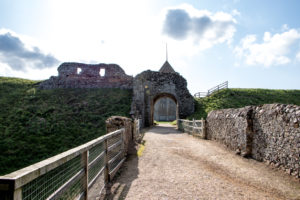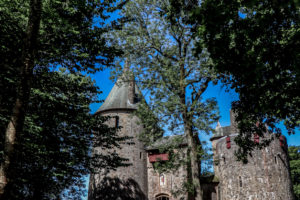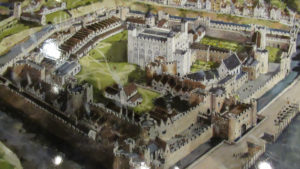



 Castle Acre Castle was built by William de Warenne, the Earl of Surrey, in the manor of Acre during the 1070s. William was a Norman lord who had accompanied William the Conqueror in the conquest of England in 1066; he was rewarded with extensive estates across England. Acre was already an Anglo-Saxon estate center and at the time of the invasion was owned by a wealthy man called Toki, but he was quickly replaced by Frederick, a Flemish lord, and William’s brother-in-law. When Frederick died around 1070, William acquired control of the manor, which formed part of his massive land holdings across the region.
The castle was strategically located where the River Nar met the Peddars Way, an old Roman road, at the center of Warenne’s other estates in Norfolk, and may have been built on top of Toki’s former house. The castle had a motte-and-bailey design: its large outer and inner baileys were protected by earthworks and palisades, and a stone gatehouse was added to the inner bailey shortly afterward. In the center of the inner bailey was a grand double-hall built from stone, but this was not fortified and would have been more like a country house than a conventional Norman keep.
William gave St Mary’s, the former parish church which was now surrounded by the castle’s outer bailey, to the Cluniac order of monks, along with 110 hectares of farmland. By 1088 a handful of monks had arrived from Lewes, where William had also founded a Cluniac community, to settle at the castle. William’s son, the second Earl William de Warrene, gave the monks a more spacious area of land to the west of the castle, probably in 1090, where they built Castle Acre Priory; the construction took a long time, and the priory was not fully completed until the 1160s. Monastic sites like the priory would have given their founders, and their associated castles, considerable prestige