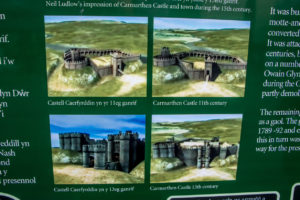



Carmarthen Castle is a ruined castle in Carmarthen, West Wales, UK. First built by Walter, Sheriff of Gloucester in the early 1100s, the castle was captured and destroyed on several occasions before being rebuilt in stone during the 1190s. The castle was captured by Owain Glyndŵr in 1405. Henry VII’s father died at Carmarthen Castle in 1456. During the Wars of the Roses the castle fell to William Herbert and, during the Civil War, was captured by Parliamentary forces. It was dismantled by order of Oliver Cromwell in the mid-1600s.
The first castle on its current site at Carmarthen is variously dated to 1104, circa 1106 or 1109, and ascribed to Walter of Gloucester, though Ludlow suggests it is more likely that the castle had already been built when Walter was recorded (in 1109) as being sent to defend Carmarthen. An earlier fort existed 1.4 kilometers south at Rhyd-y-gors, built by William FitzBaldwin of Devon on behalf of English King William II, probably after the death of the local Welsh King Rhys ap Tewdwr in 1093. It was last mentioned in 1106. Pembroke Castle had been established in 1102. The castle, originally a timber motte and bailey structure, is believed to have been rebuilt in stone in the later years of the 1100s.
12th century
It was not too long before local Welsh prince Gruffydd ap Rhys (who had had his lands taken from him by the Normans) attacked Carmarthen Castle. Around 1116 he successfully captured it in a night attack, despite the Normans arranging for it to be defended in a two weekly rotation by local chieftains. Gruffydd dismantled the castle and plundered the surrounding town. Subsequently rebuilt, the castle changed hands several times over the following decades. The North Wales prince, Owain Gwynedd (‘Owain the Great’), destroyed the castle in 1137 and it was again destroyed in 1143. Briefly recaptured in 1144, it was again taken by Cadell (the son of Gruffydd ap Rhys) in 1146 and retained for several years. Cadell’s brother Rhys again captured (and destroyed) the castle in 1195.