
Menu
 
Portfolio
 
Terms of Use
 

Ipswich Hoard


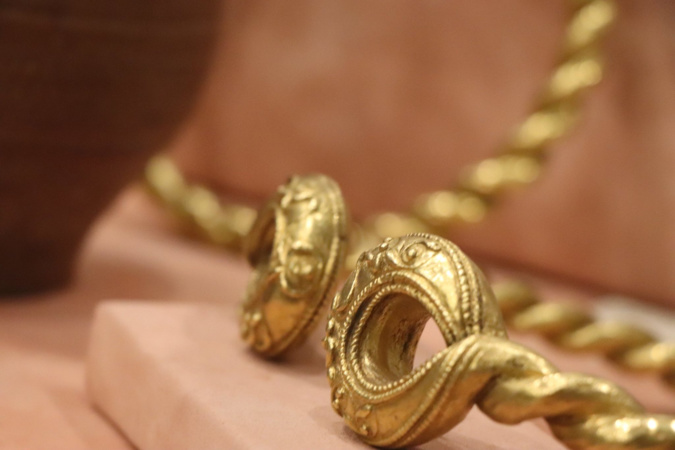
Ipswich Hoard, plus – There are two notable Ipswich Hoards. The first was a hoard of Anglo-Saxon coins discovered in 1863. The second was a hoard of six Iron Age gold torcs that was discovered in 1968 and 1969. The latter hoard has been described as second only to the Snettisham Hoard in importance as a hoard from the Iron Age.




More posts..

Seven Sisters Round Barrow

  Older than Stonehenge, the Seven Sisters Round Barrow, Copt Hill, Houghton-le-Spring was excavated in 1877. They found objects from the Neolithic and Bronze Age periods. A burial urn that they found is now in the British Museum. In 2003 a sample of charcoal was

Read More
West Stow

Prehistoric settlement: The site at West Stow has shown evidence of human habitation throughout British prehistory. Indeed, the wider Lark Valley contains the greatest known concentration of prehistoric settlements in the region of East Anglia. Mesolithic: Excavation at West Stow has discovered evidence for hunter-gatherers

Read More
Castle Rising

Castle Rising is a ruined medieval fortification in the village of Castle Rising, Norfolk, England. It was built soon after 1138 by William d’Aubigny II, who had risen through the ranks of the Anglo-Norman nobility to become the Earl of Arundel. With his new wealth,

Read More
Roman Baths, Bath

  Roman Baths (Bath) – The first shrine at the site of the hot springs was built by Celts, and was dedicated to the goddess Sulis, whom the Romans identified with Minerva. The name Sulis continued to be used after the Romans arrived in Britain,

Read More
Share on facebook
Share on twitter
Share on linkedin
Share on pinterest
error: