


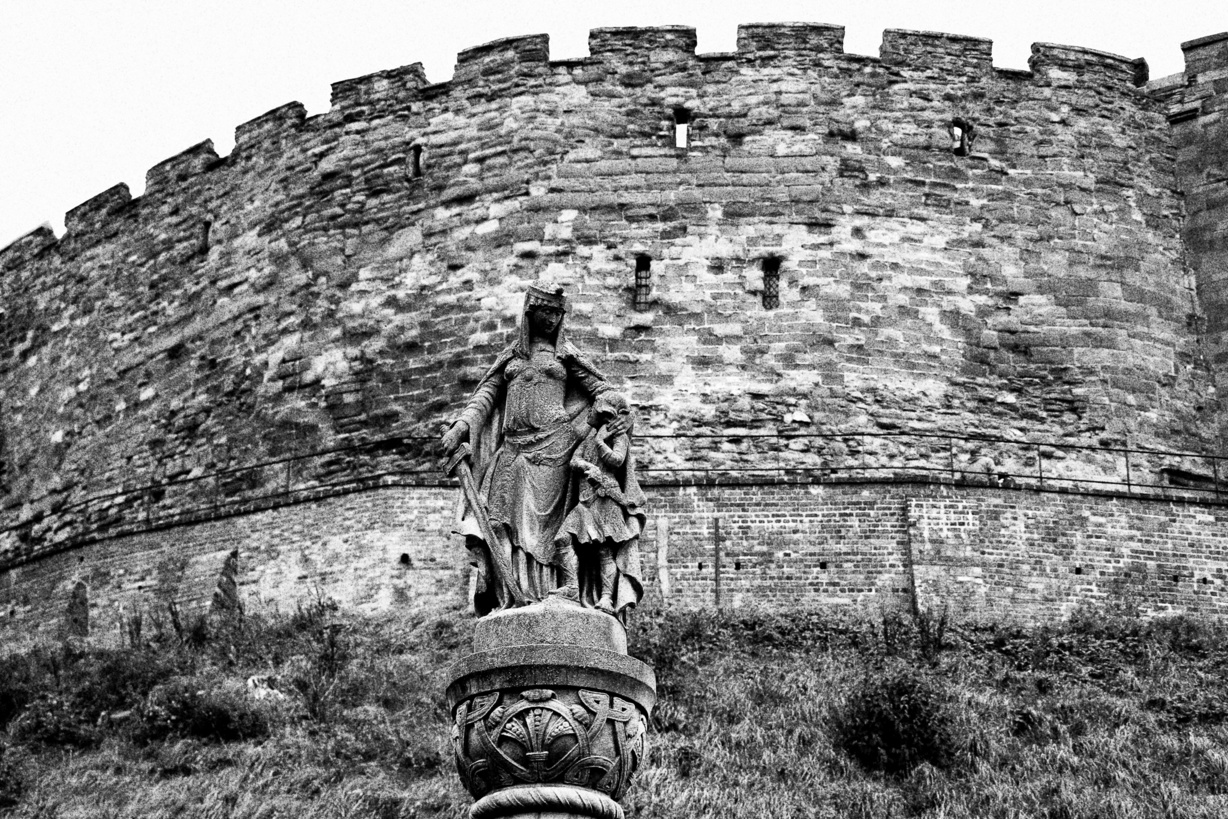
Tamworth Castle is a Norman castle overlooking the mouth of the River Anker into the Tame in the town of Tamworth in Staffordshire, England. Before boundary changes in 1889, however, the castle was within the edge of Warwickshire while most of the town belonged to Staffordshire.
The site served as a residence of the Mercian kings in Anglo Saxon times but fell into disuse during the Viking invasions. Refortified by the Normans and later enlarged, the building is today one of the best-preserved motte-and-bailey castles in England.
When Tamworth became the chief residence of Offa, ruler of the expanding Mercian kingdom, he built a palace therefrom which various charters were issued sedens in palatio regali in Tamoworthige, the first dating from 781. Little trace of its former glory survived the Viking attack in 874 that left the town “for nearly forty years a mass of blackened ruins”. Then in 913 Tamworth was rebuilt by Æthelflæd, Lady of the Mercians, who newly fortified the town with an earthen burh. This, however, did little to defend the place when it was again sacked by the Danes in 943.
Over the following centuries, there is no more mention of Tamworth as a royal residence, although a mint there struck coins for later Anglo-Saxon kings and eventually for the new Norman monarch, William the Conqueror. The place was then granted to William’s steward, Robert Despenser, who built a wooden castle during the 1080s in the typical Norman motte and bailey fashion. Occupying the southwestern part of the earlier burh, this was the forerunner of the present building.
When Robert died childlessly, the castle passed to his nieces, one of whom, Matilda, married Robert Marmion. The Marmion family, hereditary champions of the Dukes of Normandy and then of the new Kings of England, held the castle for six generations from c.1100 to 1294. It was during their occupancy that the castle began to be remodeled in stone, although on one occasion it was also in danger of being demolished altogether. Robert Marmion, 3rd Baron Marmion of Tamworth, deserted King John in 1215 during the turmoil of his reign. As a consequence, the king ordered Robert’s son Geoffrey to be imprisoned, all of Robert’s lands to be confiscated and Tamworth Castle to be demolished. But the fabric had only been partially destroyed by the time of John’s death the following year when Robert’s sons were able to regain their father’s lands.


